The Odyssey… or The Nolaney
Dear friends and frenemies as I lay here on the island of Phaecians with covid, somewhere between fever and a heatwave, please gather round to talk about the multi-sang Odysseus, the multi-awarded Nolan and their journey.
Is it even “The Odyssey”?
I know Christopher Nolan is not with us as he fastens from technology, but maybe an assistant will print this out for him. This is not the first time the Brits have done the Greeks dirty*, as we all know, but it’s a misfortune we could have avoided if the Gods inspired Nolan to get a parakeet as a pet instead of a dog. As he said in an interview, a major reason why he decided to film the Odyssey, is that he recently got a dog and he was greatly moved by the relationship between Odysseus and his dog Argus in Homer’s poem.
There are numerous adaptations of “The Odyssey” out there, some better, some worst, and this could be one more. One key difference between Nolan’s “The Odyssey” and other adaptations like “Brother Where Art Thou” and “The Return” (which I found both good) is they manage expectations right off the bat- with the appropriate title. They never claimed to be “The Odyssey”. Since Christopher Nolan wanted to film a loosely based adaptation of The Odyssey, about a war veteran with PTSD, that has the same name as Odysseus but nothing of his character, wondering around a parallel grey universe that has some stops similar to parts of Odysseus’ journey, why name it “The Odyssey”? To secure the budget or the box-office success? Or did he perhaps believe his cast that his writing is superior to the original Homeric epos? Something they concluded on, even before reading the script (with the honourable exception of Robert Pattison)?
Nolan’s dishonesty when it comes to the title of this adaptation extends to his reasoning behind his decisions. He said for instance that he cut the dialogue between Odysseus and Polyphymus because the “nobody” joke was a pun and puns in translation are tough. And although he tried, it was not possible to work in it. Yes, it would indeed be impossible to work it in, but not because it was hard to translate, it’s because his Odysseus could not possibly joke like this. Or he says that he didn’t have gods in the film and rather presented them as the raw natural phenomena or possibly as hidden as strangers, rather than portraying them as separate, physical entities up in their own world, up on mount Olympus. But Gods in Odyssey, and in Greek mythology in general, are not isolated, cut off from the mortal world, they are very much part of it. Greek mythology is human centric, Gods come to us, they have passions, faults, children with mortals, everything happens here and now.
I think the appropriate name of this project would be “The Nolaney”, since it all seems to revolve around Nolan himself. Everybody participated because of him, following him blindly in his own journey. His ametroepia (lack of measure) must have given him a blurry vision like the synonymous eye condition. Humangous budget, filming for a giant screen hardly anyone will enjoy, greedily squeezing in an all-star cast as much as possible. All we missed was Taylor Swift as a Siren. I also found it ironic that he’s anti-tech, yet in the name of technology (filming on IMAX) he sacrificed storytelling itself by cutting off the actors every 3 minutes, like Agamemnon sacrificed Ifigenia to embark on The Trojan war. It’s is also a very un-Greek way to tell a very Greek story. In the words of Protagoras “Man is the measure of all things”, that is why even Greek temples are not gigantic proportions, it’s all on human scale. So the real challenge would be to present a bigger than life adventure on a human scale. Maybe Nolan should have taken these extra nine days to think some things over.
I cannot help but feel this whole project is a hubris that he will soon pay for.
The angle
The angle Nolan chose for his adaptation is meant to be deep and modern, but it comes off forced and flat.
Holywood has already given us a plethora of veterans with PTSD, full of regret, turning “good” at the end and discovering it was all in vein. Maybe he could place it in First World War to justify the grayness and also remind us what First World War was about since the more recent films refer so much to the Second one. He could also go down the anti-war route in a more interesting way, by following the premise that Helen never really ever went to Troy, and it all happened “for an empty shirt, for an Helen” as the Nobel prize winner poet, Giorgos Seferis writes. He could have Erynies hunting his depressed Odysseus rather than having him guided by an equally depressed Athena.
It also feels trivial to have an American or British film having this very broad anti-war message. It’s easy to say stop fighting when you are the oppressor.
There is also constant reference to a warped view of Xenia. Maybe Nolan is not using AI, but his assistants do, because Xenia is an ancient Greek concept of hospitality honouring Zeus Xenios or Athena Xenia, not this Christian view Nolan talks about, respecting strangers and treating others as you wish to be treated. Changing the meaning of Xenia, which is still very much alive as a tradition, removes Odysseus’ license to brutally kill all the suitors at the end, as they had indeed violated Xenia. Also worth noting that according to myth Xenia is the reason the Trojan war started, because Paris violated Xenia being a guest of Menelaos and took off with his wife and treasures.
Of course Nolan’s message is even “deeper”. At its core it is a commentary on the collapse of the “western civilisation”. So he decided to suck out all the life of Odysseus and his journey, and add on this narrative of the sea people being the enemy within, like the Achaeus in the Trojan horse.
But maybe the problem of the “western civilisation” is exactly that, the arrogance, and inevitably the hubris, towards other cultures, towards eastern cultures, towards the Greek culture. Maybe what Nolan didn’t see while trying to warn us of the sea people, is that he is one the sea people himself.
The controversy around the cast
When I saw the cast I felt my heart drop - no lie. Worst casting choices for me being the protagonist of the play, Odysseus, and Athena.
Helen, as mentioned above, perhaps the best director’s choice would be not to portray her at all, she is after all an ideal. The irony around the debate of casting Lupita, an African woman, is that Helen was, if we ignore the myth her father was Zeus as Nolan chooses to, of African descent. Her great grandmother on Tyndarus side is Andromeda, princess of the Aethiopeans. So Nolan could have both representation and accuracy by casting someone from Northen Africa, but I guess representation was never the point.
Helen, a Spartan woman, one of the most powerful princesses and queens of mythical descent, was portrayed as a weak, abused wife. I presume that was to further juxtaposition her to her sister Clytemnestra. Although it doesn’t really make sense they would be identical twins, because then how Helen would be the standout fateful beauty that brought once the Greeks on the verge of the civil war** and then to the war with Troy? Also if the script focused on one of the two sisters, we could see a bit more depth to either character and give more room to Lupita to act. If I were Lupita and asked to pick one, I would for sure pick Clytemnestra.
And then of course he had to completely change Menelaos, who has always been the softie of the Aecheans, so Jon Bernthal casting and portrayal ended up been fine, although it felt one of the most bizarre choices before release.
Elliot Page, although doesn’t have the physic or the tan of man that comes to mind when you think Bronze Age warrior that has spent 10 years in the battlefield, gave a solid performance. However, squeezing in Helen’s presence and inventing Sinon’s role, to serve these two specific casting choices, makes one wonder if it was orchestrated as a marketing play or to position Nolan as a more progressive director, which I feel would be very unfair to the actors.
On to Odysseus now. I think we all know by now he was the main character, but the absolute trickster, not some vanilla nice guy. Matt Damon you’d trust to look over your things while you take a bathroom break, Odysseus, the grandson of the most famous thief, Autolycus, not so much.
It also made me laugh how Damon’s Odysseus, much like with Pitt’s Achilles look so funny in profile with the anachronistic helmets not fitting their cute noses properly.
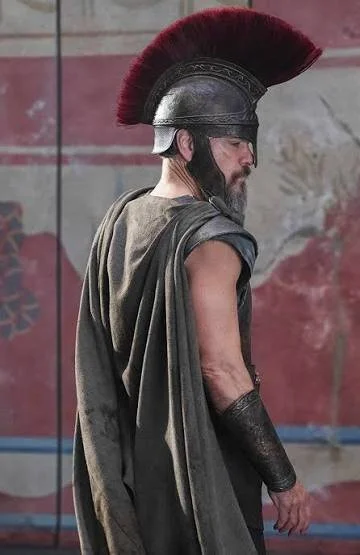
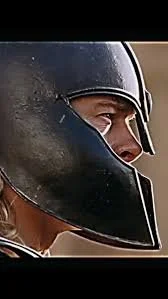
Knowing now Nolan’s Odysseus was Odysseus only by name, and not in spirit, yeah, I can believe Matt Damon is a turtured hero in a grey landscape beyond time and space. He was fine.
Same with Athena, the powerful and feared virgin goddess of strategy. Zendaya lacks the gravitas, just as she wouldn’t be a good fit to play Elizabeth I, same here. But then again when you actually see the movie, and her role in it, she’s absolutely fine.
Anne Hathaway put great efforts in the film and in the interviews, but her role was flattened. Penelope is really Odysseus counterpart, she’s much more than a faithful wife. She’s cunning and diplomatic, like Odysseus, tricked and managed the suitors for so many years, and of course put Odysseus to his final test upon his return ( one of my favourite parts that was ommited).
Tom Holland, missed the bonding scenes with his father - and yes in greek we still use “patera” in our day to day life, it’s not some formal, wooden, forgotten word.
Robert Pattison is great and I appreciate he was the most cool headed on board of Nolaney. I wonder though why Antinoos is portrayed as sleazy, malicious and diplomatic, whereas his character, as his name suggests, is the opposite of Odysseus he is not diplomatic, he is brutal, rude and violent. But maybe since we got a meh Odysseus, we got an interesting Antinoos. You win some, you lose some.
Samantha Morton, phenomenal actress, impressive work with the transformation of Odysseus men to animals, but why did they present Medea’s aunt as a bitter victim of abuse, beats me.
Long story short, same with everyone else, possibly bad casting choices for Homer’s Odyssey, but they all work for Nolan’s Nolaney.
Removing Greece from the Greek Mythology
The overall direction felt it completely disconnected Ancient Greece and its mythology from reality and it continuously living tradition. Starting from music, although Göransson’s soundtrack blending reconstructed classical instruments, custom bronze gongs, with iso-polyphonic music tradition industrial sounds (like air conditioning units), and modern synthesizers was commendable, it wasn’t as groundbreaking as presented. Reconstructed classical instruments have been used in live performances by music ensembles before “The Odyssey” and some instruments are still in use in Greek folk music. Then, moving on to the image, it cannot possibly be that it was winter for the whole 10 years Odysseus was bouncing around. The colour grade of the film, the preference to cast anybody, but mediterranean actors, the costumes, the complete erasure of the loud playful spirit of the characters, all that simply play on the irrational belief that Ancient Greek culture is not a living Eastern Mediterranean culture, but simply a moment, the beginning of “Western Civilisation”. If they used the appropriate colours, casting, music and spirit, it’d be clear as the waters of the Mediterranean sea, that Greek culture, which is still alive and well to this day, has more in common with Egyptian and Iranian culture for instance vs Anglo-Saxon culture. For instance Xenia, that I believe we are all familiar by now, which is philoxenia, is a living tradition to this day across the Mediterranean, Western Asia and Middle East, but not so much in the West. That is after all, how Airbnb was born.
So this detachment from the very real and living Greek culture adds further to its aesthetic westernisation. All this is analyzed beautifully here by Farya Faraji in this extensive video.
And for those that mistakenly parallel mythology to fantasy, to understand how deep Odyssey runs in the Greek phyche, here is an example. When Odysseus goes to the underworld prophet Tiresias instructs him, once he’s back home, to take an oar and walk inland until he meets a stranger who mistakes the oar for a “winnowing-fan”. At that exact location, Odysseus is to plant his oar in the earth and make a sacrifice to Poseidon. That exact same story was passed on in Greek folklore about Saint Nicholas, patron saint of the sailors, archers, repentant thieves. So as you see, Odyssey, has stayed with Greek people to modern day between civilisation collapses, religions, empires and philosophical schools. So no, it’s not like Batman.
Odysseus and his journey
Homeric Odysseus emerges as a full on Greek, passionate, restless, scrappy, proud, a man of many passions and many flaws, brave, unapologetic, determined, diplomatic, amorous, curious and inventive and so much more. Because of that, although he wanted to get back home, he lived his journey through and through.
Obviously Nolan wanted to find a way to make this male lead too, suffer with overbearing guilt. Maybe it’s his catholic upbringing kicking in, but listen, Christopher, in Greece we say you have to become a sinner first in order to become a saint. So it would be ok if your Odysseus too gave in to a nymph or two along the way, before embarking on his guilt trip.
Maybe Odysseus was full of regrets, maybe he was full of pride, maybe he was full of nostalgia, maybe he was full of curiosity, but through it all, he was full of love for life. That is why it took so long to get back, he lived it all to the fullest. And that’s why he was ready to set off again, once he settled back home.
But I guess Christopher Nolan and Elon Musk agree on more than just the existential danger to the “western civilisation”, they both feel you should speed through the homeric epics.
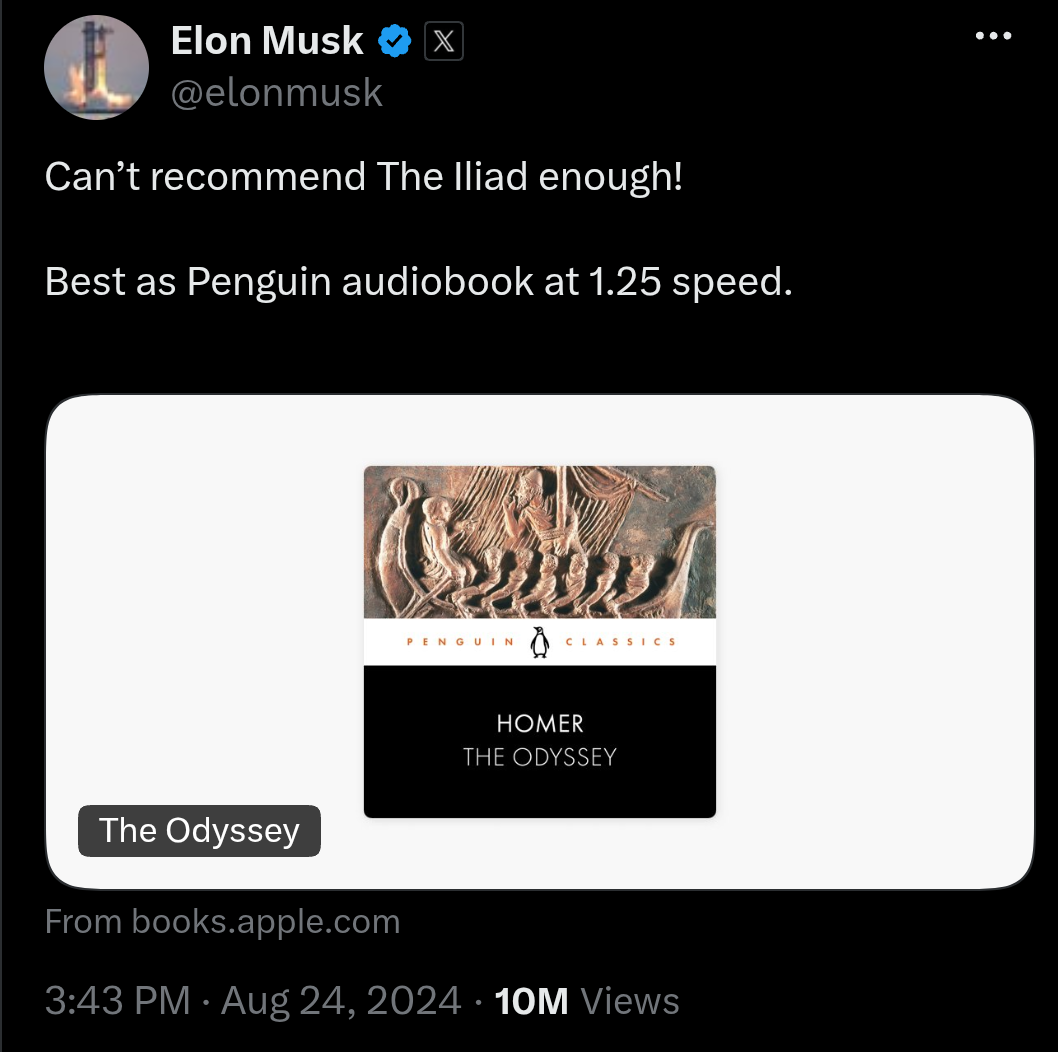
Alas, unproductive as it may sound, the whole point of the journey is the journey itself. C.P. Kavafy wrote in Ithaka: "As you set out for Ithaka, hope your road is a long one, full of adventure, full of discovery... Ithaka gave you the marvellous journey."
Removing Odysseus' meeting with his mother in the Underworld, one of the most touching scenes in the entire poem, was pure blasphemy. Anyone who's dated a Greek man can attest that he would most definitely go and see his mother instead of Sinon.
Maybe Nolan's next film should be Zorba, except instead of Crete it takes place in Norway, and Zorba spends the film battling addiction, and crippling guilt—of course, only to eventually discover intermittent fasting and yoga.
All in all, not bad
All in all, the film itself wasn’t bad and it would have been received more favourably if it was more honest about its intentions. Is it going to be memorable in the long run? I doubt it. It’s not that entertaining either, so we won’t be watching it at least once per year as we do with Cinecittà and other technicolour productions. However, it became an excellent conversation starter and I’m grateful for that, as we had some great thoughtful commentary on the film and the Odyssey in general. I’m going to add links to some of my favourite below, but before that, let me share some beautiful words woven together by the author Elif Shafak:
Odysseus is the hero of amazing adventures. He has achieved extraordinary things and yet at the end, he yearns to return to his craggy, humble Ionian island because it is home…Homer understood something crucial about human beings: a universal truth that many populist demagogues and agitators, sometimes deliberately, sometimes out of sheer ignorance, fail to comprehend today. Nobody wants to leave their home, and nobody will leave home unless they have no other option. When we talk about refugees today, we need to understand what Homer understood so well, long ago,
Odyssey related links:
Religion for Breakfast has done a few videos relevant to the topic, including one on the identity of the mysterious sea people.
Let’s talk religion has a great video on religion in Ancient Greece and one on Porphyry's commentary on the Cave of the Nymph.
On the Faculty of Classics, University of Cambridge channel, Classics at Cambridge we have number of Ivy League and Oxbridge historians take on the film.
* Elgin and the Parthenon Marbles, Dekemvriana, Ioannis Kapodistrias Assasination, etc
** After Agamemnon married Clytemnestra, all the Greek kings gathered in Sparta as suitors to Helen, the most beautiful and wealthy princess of Greece, and it would lead to a civil war, if Odysseus, cunning as he was didn’t step out of the competition early on to ask for Helen’s cousin, Penelope, instead and offer a solution to Tyndareus in exchange. The solution was the Tyndareus oath, that all the kings would pledge allegiance to whomever Helen picked as her husband. And because of the Tyndareus oath they all joined forces with Agamemnon and Menelaos against Troy.